

Q&A Frequently Asked Questions
We will answer your questions about urethane, from simple to specialized.
What is low-resilience elastic foam?
What is low-resilience foam?
Soft urethane foam is a "viscoelastic foam" that combines the "elasticity" of a spring with the "viscosity" of clay or gum.
Low-resilience foam, also known as low-resilience foam, is a type of soft urethane foam designed with a special molecular structure that reduces elasticity and increases viscosity. It also possesses the properties of a high hysteresis loss (JIS K 6400-2), making it a shock-absorbing foam. Its interconnected cells allow it to slowly return to its original shape after compression and subsequent removal of external force. Its resilience is approximately 15% lower than that of standard foams (JIS K 6400-3). This relatively soft foam, used in pillows, bedding, and chairs, not only feels pleasant to the touch, but also minimizes localized pressure and distributes body pressure throughout the body, effectively preventing blood flow obstruction and bedsores. Its demand in nursing care products has been expanding in recent years. Its shape memory, shock absorption, and vibration-damping properties also make it widely used in the automotive and precision equipment packaging industries. While this type of foam tends to harden at low temperatures, its molecular design allows for a tolerable change in hardness even during normal living conditions, such as winter.
What is the composition of low-resilience elastic foam?
- (1)Low-resilience foam, like general urethane foam, is made by mixing and foaming a blowing agent, foam stabilizer, catalyst, etc. with polyol and polyisocyanate as the main ingredients, but additives such as colorants and flame retardants may also be used as needed.The raw material for low-resilience foam is characterized by the structure of polyol, which has a slow recovery after compression and the polyurethane resin composition is viscoelastically modified to enhance energy absorption performance.
- (2) While low-resilience materials made from silicone or polypropylene are well known as shock-absorbing materials, materials known as low-resilience foams are generally open-cell foams composed of polyurethane resin. Generally, adding large amounts of oil to rubber or plastic reduces resilience, so these types of solids or foams are used as vibration-damping and shock-absorbing materials in equipment, shoe soles, etc. However, these materials have not been put to practical use as cushions for seats or bedding because they are too hard, lack low resilience or slow recovery, are heavy, and suffer from contamination and odor due to additive leaching. As such, they differ significantly from foams that achieve low-resilience performance primarily through the molecular design of polyurethane rather than through the addition of oils.
Therefore, it is safe to assume that "low-resilience elastic foam" for seating and bedding applications is an abbreviation for "low-resilience elastic urethane foam," but please check the product quality label for more details.
What are the features of low-resilience elastic foam?
- 1) Low-resilience elastic foam is a type of soft urethane foam, so it can provide a wide range of suitable physical properties and performance to meet your needs.
By selecting the combination of polyols, polyisocyanates, foaming agents, foam stabilizers, colorants, and other compounding agents, the mixing ratio, and manufacturing conditions, we can provide the performance required for a variety of applications.
In other words, it is lightweight and has excellent shock absorption, vibration control, body pressure distribution, sound absorption, and heat insulation properties, and it can be colored in a wide range of colors.When used in cushions for pillows, futons, mattresses, chairs, etc., the low-resilience foam changes shape to fit the shape and movement of the body, such as the head, neck, waist, and buttocks, and body pressure is distributed rather than concentrated in specific areas, so it is now being used as a comfortable and healthy cushion. - (2) Resilience
Soft urethane foam will instantly recover when compressed and the external force is removed, but low-resilience elastic foam has the property of returning to its original state slowly.
However, please note that the restoration speed varies greatly depending on the type of form.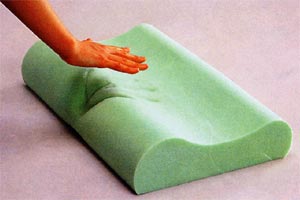
Resilience (image) - (3) Temperature sensitivity
Low-resilience foam has the property of becoming softer as the temperature rises and harder as the temperature drops, which is called temperature sensitivity. This property is more pronounced with low-resilience foam than with regular foam, but please note that temperature sensitivity also varies depending on the normal hardness and the speed at which the foam returns to its original shape after compression.
Furthermore, physical properties such as hardness change with temperature changes, and when cutting, if the temperature drops below 10°C, the foam may become difficult to cut with some cutting machines, so we recommend processing at temperatures above 10°C whenever possible.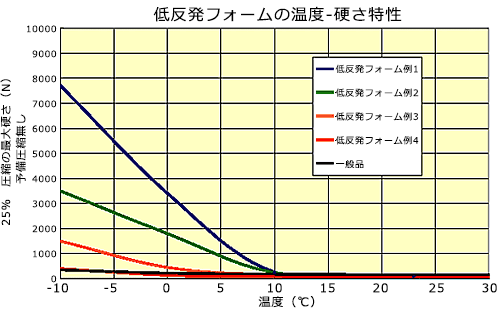
Temperature sensitivity (example) - (4) Shock absorption
When a golf ball is dropped onto low-resilience elastic foam, the ball bounces up much less than with regular foam or high-resilience foam.The following is an example of an experiment to examine the impact absorption of low-resilience elastic foam when an iron ball is dropped directly onto it.Shock absorption (example)
"Impact absorption test" (The lower the number, the higher the impact absorption capacity)
*If a 200g piece of iron is dropped from a height of 15cm on a fixed surface with nothing placed on it, the impact force will be more than 2000G.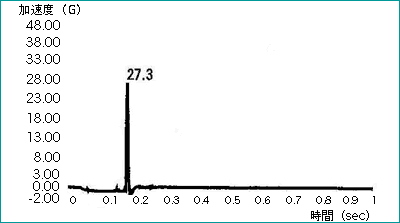
Low-resilience elastic foam 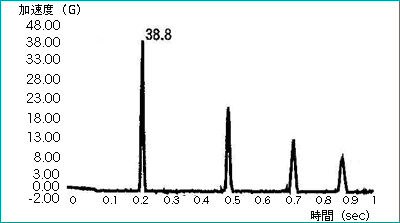
Regular urethane foam Experiment Description
This shows the impact absorption performance when a 200g iron ball is dropped directly onto the foam surface from a height of 150mm.
The impact acceleration of regular urethane foam is 38.8G, while that of low-resilience foam is 27.3G, and the number of rebounds is also 3 for regular urethane foam, while that of low-resilience foam is 0. It absorbs impact instantly and does not rebound. - (5) Body pressure dispersion
Low-resilience elastic foam has excellent shock absorption properties, and when a certain load is applied, the stress of the foam is distributed over the load area, preventing localized pressure, which reduces compressive load and is effective in preventing blood flow obstruction and bedsores, leading to its use in nursing care products, etc. Next, we will show the body pressure distribution (pressure distribution) when lying on low-resilience elastic foam and regular foam.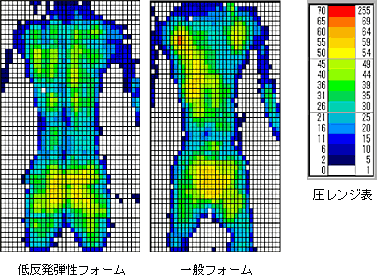
Body pressure distribution (Example 1) Body pressure distribution (Example 2)
[Test conditions] Sample size 50×400×400 mm subject Height 168cm, Weight 65kg, Room temperature 15℃ Measurement conditions Sit on a chair and measure for 5 minutes with your heels, knees, and hips at a 90-degree angle result
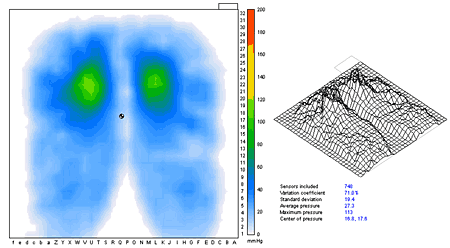
Low-resilience elastic foam density 80kg/m3 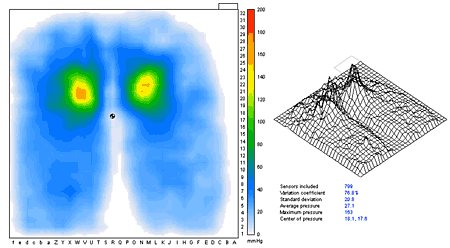
Low-resilience elastic foam density 80kg/m3
What are the standards for memory foam?
- (1) Low-resilience foam is available in slab and molded products. Slab foam is cut into various shapes, while molded foam is commonly used to make pillows, mattresses (bedding), and other molded products. Typical physical properties of the standard are density, hardness, and resilience, but depending on the type, special performance of the foam may also be standardized. Low-resilience foam generally has the property of changing hardness with temperature (thermosensitivity). Furthermore, its unique feel and recovery speed, which are difficult to express in standards, are often not specifically standardized, and are instead determined through discussions with users based on their intended use.
- (2) Foam properties
Below are examples of foam properties for low-resilience elastic foam.Foam properties (example) Physical properties Low-resilience elastic foam General Form High Resilience Foam density kg/m3 40 60 80 20 40 40 Hardness(1) N 53 28 40 110 130 18 Rebound Resilience (2) % 4 2 2 40 50 6 Compression deflection test (3)
Hysteresis Loss% 56 61 68 44 42 34 Note (1) Hardness (JIS K 6400-2)
A 50 x 380 x 380 mm test piece is cut out from the product and pressed vertically to 75% of its original thickness. The load is then immediately removed and the piece is pressed again to 25% of its original thickness. The load is read 20 seconds after the piece has stopped.Note (2) Resilience (JIS K 6400-3)
A test piece of 50 x 100 x 100 mm or more is cut out from the product, and a steel ball with a diameter of 16 mm and a mass of 16 g is dropped from a height of 500 mm from the top surface of the test piece, and the maximum height of the rebound is expressed as a percentage of the drop height (500 mm).Note (3) Compression deflection test (JIS K 6400-2) Cut out a 50 x 380 x 380 mm test piece from the product and press it vertically to 75% of its original thickness, then return the pressure plate and leave it for 3 to 5 minutes. Then press the pressure plate again to 75% of its original thickness, then return the pressure plate at the same speed and graph the history at that time.
Compression deflection curve (example)
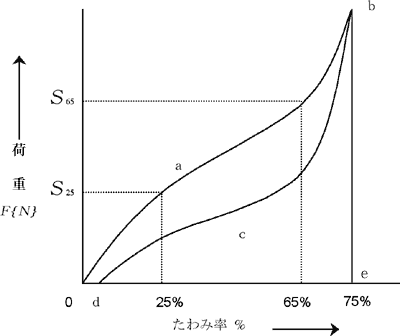

Low-resilience elastic foam density 80kg/m3 (3)Specially shaped products
By combining soft urethane foam products with other materials or cutting them into special shapes, they can achieve cushioning with special properties that are difficult to achieve with foam alone, and various products are being considered, so it may be a good idea to press the product lightly before purchasing.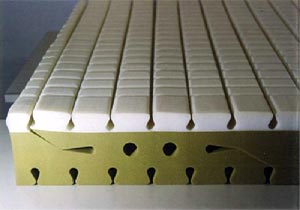
Specially shaped cut products (examples) As described above, low-resilience elastic foam has significant advantages over other plastic foams and similar fiber materials (cotton, felt, etc.), so it is used in a variety of applications, including automobiles, household items, and nursing care products, and quality improvements and expansion of applications are still ongoing.
How do factories produce memory foam?
Low-resilience elastic foam is manufactured in the same way as general soft urethane foam, and is produced in the form of "slab" or "molded" products at the manufacturing plant.
"Slab" products are made by running the mixed liquid on a continuous conveyor, and after continuous foaming, which is usually 1-2m wide and 0.2-0.6m high with a square or kamaboko-shaped cross section, it is cut into the shape of a loaf of bread of the specified length (usually 1-2m). It is shipped to processing plants in this form, and products of various shapes can be cut and processed from the slab.
Molded products are made by injecting the concentrate into a plastic or metal mold, foaming it, and then removing it from the mold. This allows for the molding of large quantities of products with complex shapes with good dimensional precision.
Where is low-resilience elastic foam used?
The main uses of low-resilience elastic foam are as follows:
| classification | Application example |
|---|---|
| Vehicle | Cushions for racers (shape memory retention), cushions for astronauts, cushions for child seats |
| furniture | Chairs, floor chairs, cushions |
| bedding | (Nursing care) Mattresses, futons, pads, pillows |
| Interior | Cushions and various cushions |
| packaging | Precision equipment cushioning material |
| Daily necessities | stuffing such as stuffed toys |
| Others | Wheelchair cushions, bedsore prevention equipment |