Q&A Frequently Asked Questions
We will answer your questions about urethane, from simple to specialized.
How to choose soft urethane foam products for cushions
Soft polyurethane foam is widely used in bedding, interior items, and furniture, but what criteria should you use to make your selection?
- (1) The Urethane Foam Industry Association recommends that mattresses 50 mm or thicker be fitted with a quality label in the format specified by the Household Goods Quality Labeling Act. When purchasing, please first check whether or not this quality label is present.
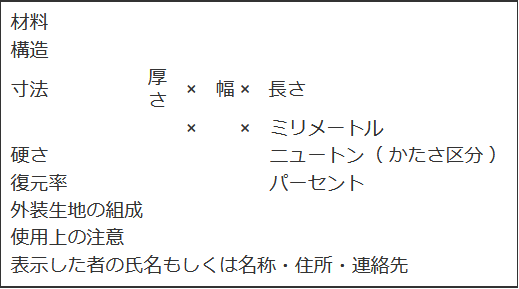
Table 1. Labeling format based on the Household Goods Quality Labeling Act (length: 8cm or more x width: 10cm or more) The hardness column of this quality label contains numerical and letter indications based on the following hardness classifications, so it is recommended that you use this as a basis for selecting the hardness.
- (2) For bedding, interior goods, and furniture products, the Urethane Foam Industry Association implements the "Excellent Urethane Foam Labeling System."
This system applies to bedding and interior products.
Apparent density: 20±2kg/m3 or more
Residual compression strain: 6% or less
For the foam and seat cushions of furniture,
Apparent density: 25±2kg/m3 or more
Residual compression strain: 6% or lessFurthermore, bedding, interior items, furniture, etc. that use these foams can be labeled with the "Excellent Urethane Mark" after going through the prescribed procedures.
When purchasing, we recommend products with this mark first.
Figure 1. Excellent urethane mark
How do you measure the firmness and recovery rate of a mattress?
Hardness is measured according to JIS K 6400-2 (Method D), and recovery rate is measured according to JIS K 6400-4 (Method B). The test methods are outlined below.
[Hardness]
The foam inside the mattress is laid flat, and a 200mm diameter circular pressure plate is placed on top. The pressure plate is then pressed down to 75% of the foam's original thickness, then returned to its original position, and pressed down again to 25% of the original thickness. This pressure is then left to stand for 20 seconds. The load value, expressed in N (Newtons), is the firmness of the mattress.
[Recovery rate]
The test piece is a square foam with a side length of 50mm or more and a thickness of 20mm or more, and is compressed 80,000 times at a speed of 60 times per minute over a distance of 50% of the thickness, and then left at room temperature for 30 minutes, after which the thickness of the test piece is measured and the residual strain rate (%) from repeated compression is calculated. The recovery rate is calculated by subtracting this value from 100.
Therefore, the higher the mattress hardness number, the harder it is, and the higher the recovery rate number, the less thickness will decrease with repeated use.
What is the identification and material marking for urethane foam plastic containers and packaging?
In order to promote the effective use of resources, plastic containers and packaging are required to display an "identification mark" (commonly known as the "Plamark") in a format prescribed by law (penalties apply to containers and packaging manufactured or imported after April 1, 2003). In addition to the "Plamark" identification mark, it is recommended (though not legally required) that plastic materials be indicated using the resin abbreviation specified in JIS K6899-1 on plastic containers and packaging. The material indication symbol for polyurethane foam is PUR.