

Magazine
NEW
PeopleFrom young employees to veterans, everyone works together as "one team" at Archem Business Japan Tosu Plant.
~The honest opinions of young and mid-career employees working on the front lines~ [Part 2]
NEW
PeopleFrom young employees to veterans, everyone works together as "one team" at Archem Business Japan Tosu Plant.
~The honest opinions of young and mid-career employees working on the front lines~ [Part 2]
Following on from the first part, we present the second part of our interview with Archem Business Japan Tosu Plant. In the first part, we heard about the strengths of the Tosu Plant from the perspective of the leaders who oversee the plant. In this second part, we bring you the real voices of young and mid-career employees who support the manufacturing site on the front lines of daily production, production control, and shipping of urethane products.
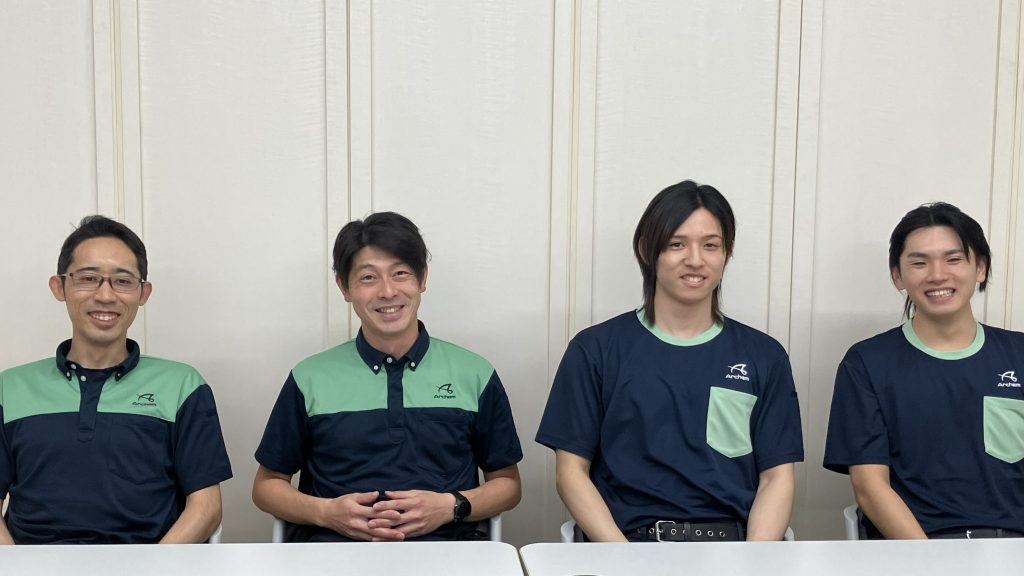
Characters appearing in the second part (from left to right)
Takuya Nakao (Tosu Factory, Operations Section 1, Shipping and Production Command, 4th year with the company) is the "command center" of the factory, mainly responsible for coordinating orders and deliveries with customers for seat pads, daily production simulations, and shipping management.
Takuma Haraguchi (Foreman, Manufacturing Section 2, Tosu Plant) is the on-site leader who oversees the entire manufacturing line for automotive and industrial urethane. He practices high-level skill transfer and creates a workplace environment that produces high quality.
Kazuki Kawashima (Tosu Factory, Manufacturing Section 1, 1st year employee) is in charge of processes such as "removing" and "assembling" sheet pad products on the Manufacturing Section 1 line. Supported by the warm atmosphere on the factory floor, he is steadily improving his skills every day.
Jinya Tamoto (Tosu Factory, Manufacturing Section 1, 2nd year at the company) Like Kawashima, he is in charge of practical work such as "removing" and "assembling" products. Despite his young age, he supports the factory floor with his meticulous work.
| A small, elite team takes on the challenge of creating products with "overwhelming satisfaction."
—In the first part of this interview, we learned that meticulous craftsmanship and teamwork by human hands greatly influence the quality of the product.
Please tell me about the characteristics of the on-site operations and what you find most interesting about this job.
Foreman Haraguchi: Our workplace is what you might call a "small but elite" team. That's why teamwork is the most important thing. Everyone does their best in their respective roles, following the production plan we've established beforehand. As a result, when we achieve our production targets faster and more efficiently than planned, the whole team can share a sense of accomplishment.
| A system of "improvement suggestion boards" where everyone, regardless of age or position, works together to eliminate "difficulties."
—Because you are working on-site with a strong sense of responsibility in manufacturing, I think there are some members who feel anxious, wondering, "What if I make a mistake?" or "Is it okay for me, who has just been assigned to this position, to voice my opinion?"
A "hearing board" where everyone, from junior staff to veterans, writes their thoughts.
Foreman Haraguchi: For example, when you're walking around the construction site, you inevitably notice small things like, "This is a little difficult to do," or "This movement might be a little dangerous from a safety standpoint." We have a board at the site where anyone can freely write down these things (commonly known as the YKI board: a board for writing down things that are difficult, tough, or frustrating). Regardless of position or age, we ask everyone to write down the points that they find YKI, and then we post them on the board.
We foremen review the collected opinions weekly and translate them into concrete "measures" on a cycle of approximately one month.
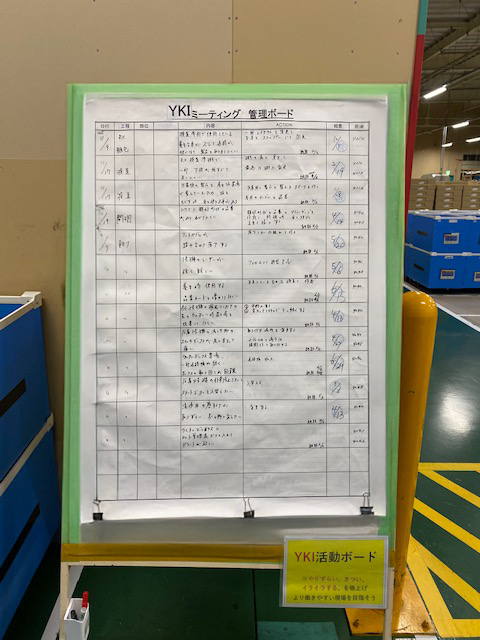
YKI Board: Anyone can write down their thoughts, and the team will work together to come up with solutions to improve the written opinions and implement them immediately.
—Can I write anything on the board?
Foreman Haraguchi: Yes, it's completely free! Sometimes it's a straightforward request like, "This is difficult to do!", or even something like a little bit of selfishness (laughs). But that's fine. The most important thing is to get people to speak up honestly. We listen to their voices and gradually improve the site, starting with what we can do. We've gone through this process many times since around 2024, and as a result, safety and quality on site have improved, and it has now become an established culture of improvement.
—Foreman Haraguchi says this, but... what do you all actually think?
Kawashima: That's absolutely true, there's an atmosphere where you can talk about anything! Of course, the seat pads we're in charge of are related to the safety and comfort of cars, so the responsibility is great, and there are challenging times. But even when there's a mistake or a problem, you're never scolded without explanation. The senior staff work together to think about "how to prevent it from happening again," so you can focus on acquiring skills without fear and in a relaxed environment.
Tamoto: My seniors are always friendly and approachable, which makes me feel very comfortable at work. Even when I first joined the company, my seniors would reach out and ask, "Is there anything you need help with?" It's because of this environment that I can approach my assigned tasks with pride.
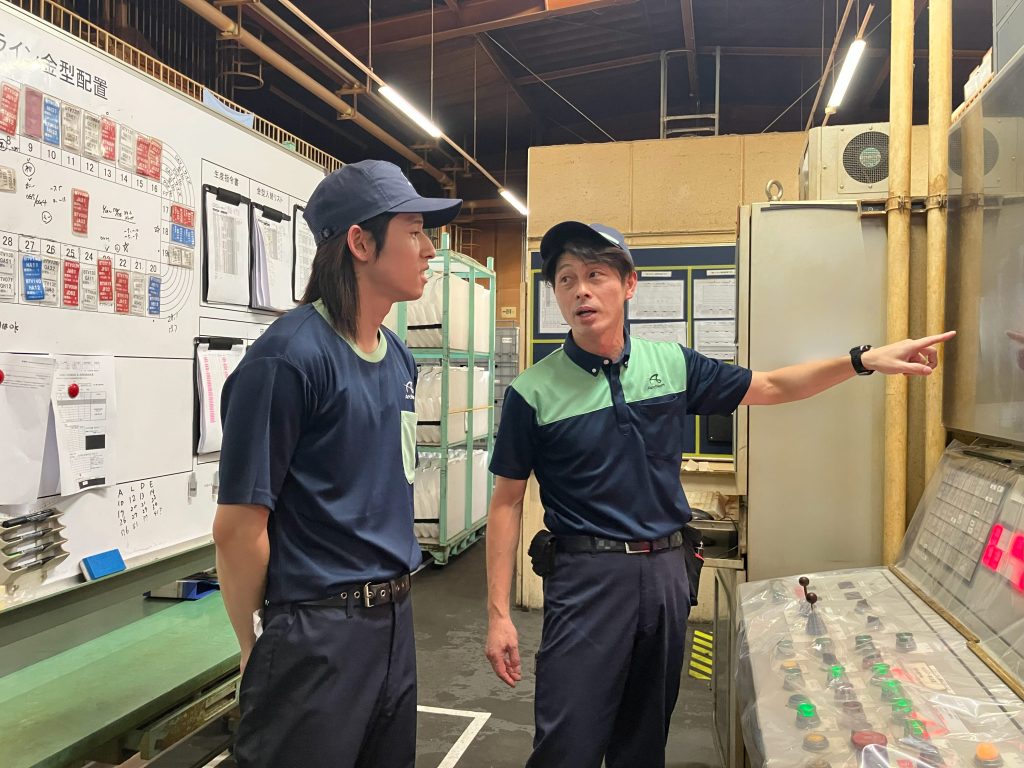
Supporting manufacturing: "Foresight" and "Teamwork" down to the second.
Looking beyond the factory, Archem 's work is directly connected to a crucial hub in the massive automotive industry's supply chain. Urethane components for seat pads, interior products, and consumer goods shipped from the Tosu factory are mainly delivered to automotive seat manufacturers and business partners in Kyushu, and are installed in the seats and interiors of popular car models that you often see on the road.
This is where the "production command" role, which Mr. Nakao is in charge of, becomes important.
Nakao: In the automotive industry, a system called "Just-In-Time (JIT)" is used, which involves producing what is needed, when it is needed, and in the required quantity. (This is a core concept of the production system established by Toyota Motor Corporation (Toyota Production System = TPS), and is now adopted in factories all over the world.)
In line with our customers' production lines, we manage production and shipping in real time, where every second counts.
—For JIT to work, Mr. Nakao's "foresightful judgment" will be crucial to the fate of the entire factory, won't it?
Nakao: That's right. For example, when a typhoon or heavy rain is expected, if we just wait for official information on whether our customers' lines will be shut down, our initial response will be delayed. That's why I make sure to stay in close contact with the drivers of the transportation companies that deliver goods from far away. I get real-time information directly from the drivers on the ground, such as "What are the road conditions like locally?" and "Are there likely to be restrictions on the highways?" and I use that information to predict our customers' movements.
I propose decisions to my team and upper management such as, "Given this situation, there's a possibility that our customer's production line will be affected in a few hours. Therefore, let's adjust our factory's operations to be earlier than planned." The pressure is immense, but the sense of accomplishment when we manage to control the situation is incredible.
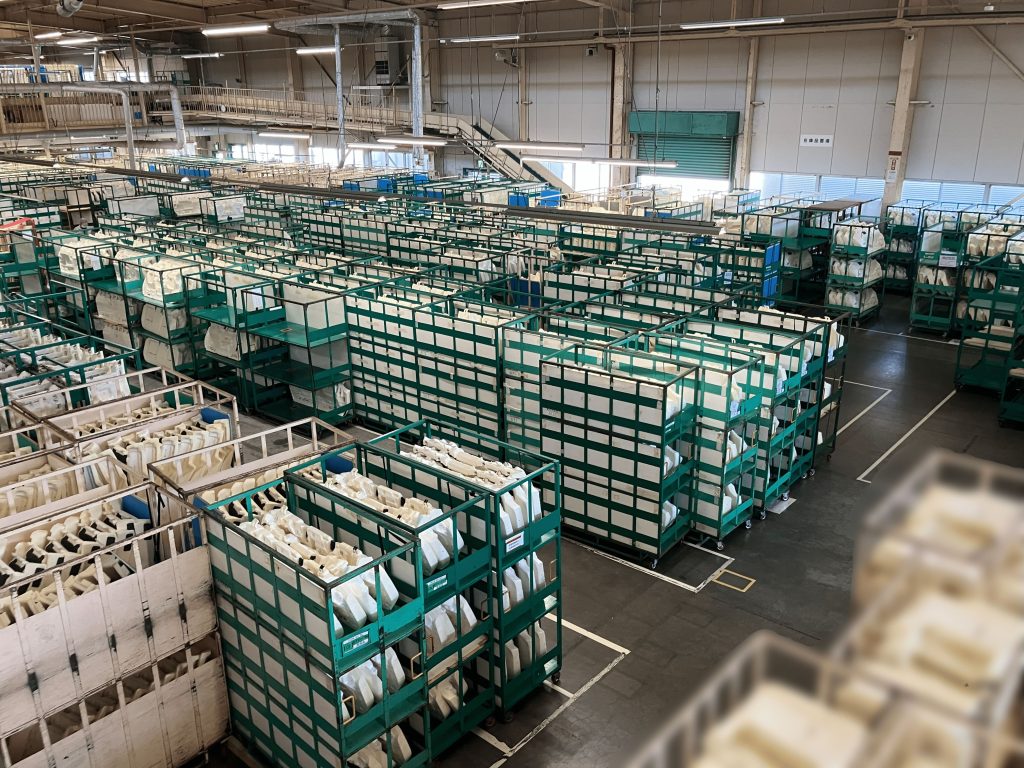
Seat pads awaiting shipment, arranged according to the order of the customer's assembly line.
—Supporting our customers' production lines with our ability to anticipate and think ahead— This scale of responsibility must be a great source of pride for those working at Archem.In the first part of the interview, Mr. Naoe, the general manager of the factory, spoke about the importance of proactively preventing problems, and it is clear that this awareness is deeply ingrained in every single person on the factory floor.
| For those who "think for themselves and make suggestions." We support the growth of each individual.
—Mr. Haraguchi, what do you keep in mind when training new members who join the team?
Foreman Haraguchi: When you first join the company, you don't know anything. So, we start by focusing on "safely and correctly performing the tasks you're told to do."
For those who can perform their tasks correctly, we encourage them to proactively share improvement ideas and insights gained from their daily work, offering advice and guidance. Ultimately, we want them to reach a level where they can even think of solutions themselves and propose, "Foreman, I'd like to change this like this!"
In fact, some of the younger employees who initially couldn't offer any opinions are now proactively suggesting improvements. When I see these steps of growth in those junior colleagues, I truly feel, as their mentor, that "I'm so glad I got to work with this team and be involved in their development."
—You two are currently in your second year at the company. What kind of career paths do you envision for the future?
Kawashima: First, I want to steadily build up my skills and contribute by perfectly completing each role assigned to me. Then, I want to keep moving up the ladder and eventually become a leader who can lead the factory!
Tamoto: I'm grateful that I received thorough training and was able to grow with peace of mind. That's why, someday, when team members are in trouble, I want to be able to teach them and be someone they can rely on.
| What's the reality of work-life balance and benefits? "Over 80% of men take paternity leave" and "work-life balance"
Archem Business Japan will begin recruiting high school graduates for manufacturing and maintenance positions starting July 1, 2026.
Please tell us about the realities of working at Archem Business Japan, including its work environment and benefits, which are of interest to job seekers.
Foreman Haraguchi: To be honest, I think there are quite a few people who had the image of manufacturing sites from a while ago as being "tough and demanding." But now it has changed 180 degrees.
The speed at which "work style reforms" and updates to the work environment have progressed in recent years is truly remarkable. Compensation, including salaries and allowances, has been significantly improved, and above all, employee benefits and vacation systems have become much more comprehensive.
Kawashima: It's easy to take paid leave. It's also easy to make personal plans, and I feel that a high level of work-life balance is maintained.
Foreman Haraguchi: In fact, one of our male team members is planning to take three months of paternity leave. There was a time in the past when people would say, "A man taking paternity leave?", but now we all send him off with smiles, saying, "Congratulations! We'll keep the site operations running, so go and support your family!"
However, I do make sure to warn the members who are about to become first-time fathers, "Parental leave isn't a vacation; it's a tough battle of housework and childcare! Make sure you contribute properly at home!" (laughs)
—An organization that cannot cherish its employees' families cannot create products that truly impress our customers.— It is this shared understanding that allows us to create an environment where employees who value work-life balance can grow into professionals.
Kawashima and Tamoto: All of us are looking forward to the day when we can work together at the Tosu factory.
[Last half of interview]
Just like the management interview in the first part, this interview was filled with laughter from beginning to end. The open atmosphere and the strong bond of a team that cares for one another were qualities that cannot be fully conveyed in print. There is a relationship of trust in which no one in need is ever left alone. And there is a sense of professional pride in supporting the production lines of their clients. I felt that it is these two pillars that allow them to continue to be a model factory that leads the group.
If you're even slightly interested, please feel free to contact us through Archem Business Japan recruitment page. We wholeheartedly support your endeavors.
☞ Archem Business Japan Careers Page: https://www.archem.co.jp/recruit/acbj/