

Magazine
NEW
PeopleManufacturing at the Hofu factory: Taking on challenges with close relationships with customers and outstanding teamwork.
NEW
PeopleManufacturing at the Hofu factory: Taking on challenges with close relationships with customers and outstanding teamwork.
The Hofu Plant is responsible for manufacturing urethane foam for automotive seats. Its strengths lie in its ability to respond quickly, thanks to its location right next to the customer, and in teamwork that transcends departments and generations.
This time, we spoke with three members who are active on the front lines of quality assurance, technology, and manufacturing, including the factory manager, about their dedication to their work and the unique appeal of the Hofu factory.
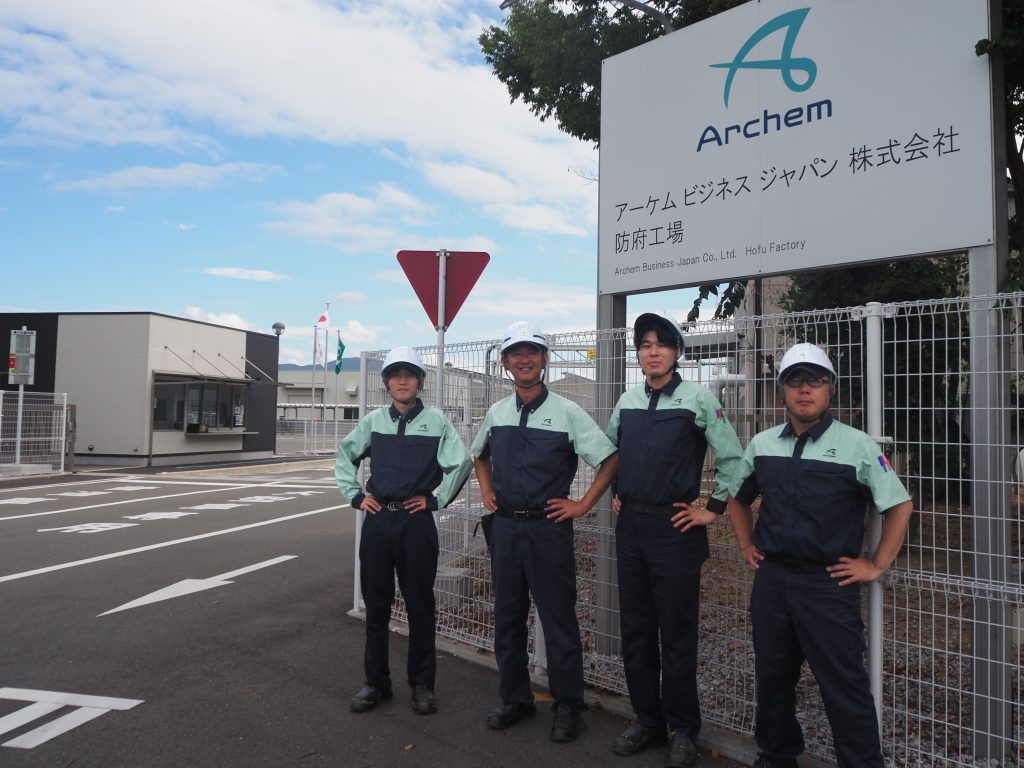
(From left to right in the photo)
Kota Fujikawa (Manufacturing Department / Joined the company as a new graduate in 2019):
I'm in my seventh year with the company. Based on the know-how I've cultivated in the manufacturing field, I transferred to the technical department in July 2026, where I'm in charge of quality improvement activities and prototyping for new vehicle models.
Fumio Tanabe (Hofu Plant Manager / Joined the company as a new graduate in 1991):
Now in his 35th year with the company, he combines a field-oriented perspective with a management viewpoint, leading the creation of value unique to the Hofu factory.
Yuya Koyama (Manufacturing Department / Joined the company as a new graduate in 2020):
Sixth year at the company. Responsible for "demolition work," which involves removing urethane for automobile seats from molds. Having gained experience on the job, he is now also active as a sub-operator (operator and adjuster) of an automated raw material injection robot.
Fumihiko Fukuda (Quality Assurance Department, Management Section / Joined the company as a new graduate in 1991):
Now in my 35th year with the company, I leverage my extensive experience in manufacturing to handle product quality control and customer service. I act as a bridge between the manufacturing site and our customers.
| The closeness and speed that comes from being a small, elite team
— First, could you tell us about the work you usually do?
Fukuda: I work in the Quality Assurance Department, where I'm in charge of quality control, maintenance, and customer support for seat pads. I have over 30 years of experience in the field, so I value "connecting the hard work of the field staff to results" and "open and transparent communication." I strive to be a "bridge" that properly conveys the voices of the field staff to our customers and feeds back the delicate requests from our customers to the field.
Fujikawa: I've been working exclusively in the field since joining the company, but I was transferred to the technical department in July of this year. Currently, in addition to quality improvement activities, I'm mainly in charge of prototyping new vehicle models. I value the perspective I've cultivated in the field and strive to create processes that consider not only quality from the prototyping stage, but also ease of operation and productivity during mass production.
Koyama: I work in the manufacturing department and am in charge of "demolition," which is the process of removing urethane sheets from molds. It may seem like a simple removal process, but it is an important role in checking each product and mold for scratches or abnormalities to ensure they are in the best possible condition for the next process. Lately, I've been working as a sub-operator to acquire the skills to become an "operator," which involves operating and adjusting the robots that automatically inject raw materials into molds!
— Ms. Fukuda, you usually act as a "bridge" between the factory floor and our customers. Are there any moments when you feel that the relationship with our customers is unique to the Hofu factory?
Fukuda: Our Hofu factory is located "just a stone's throw" from our customers' bases, giving us the advantage of being able to rush there immediately and inspect the actual products in person if anything comes up. Our ability to respond quickly and agilely to urgent requests is highly valued by our customers.
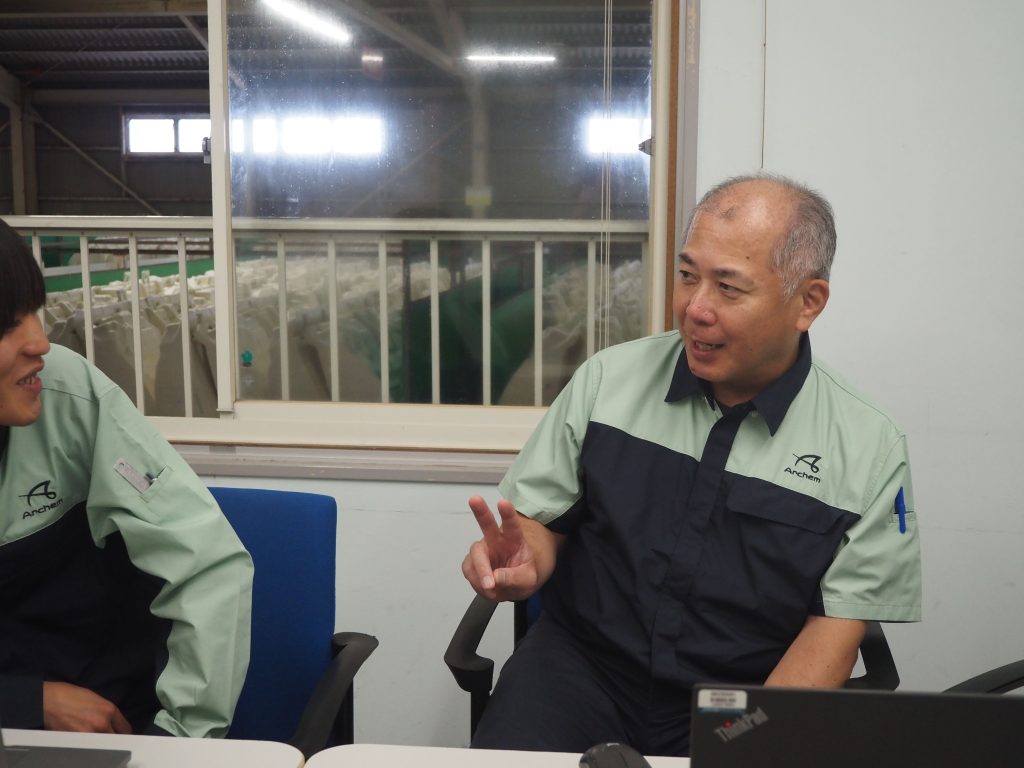
Based on her many years of experience, Ms. Fukuda (right) speaks with a smile about her feelings towards the workplace and her job.
— Since it's a part that directly affects seating comfort, I imagine the demands placed on it are quite high.
Fukuda: That's right. Of course, we have to meet the specifications on the drawings, but in recent years, there has been a demand for even higher quality in terms of feel, such as ride comfort and tactile sensation. Even when it comes to something as simple as a seat pad, the specifications required differ in detail for each part, such as "the part that supports the body in curves should be firm, but the part where the buttocks touch should prioritize comfort." I feel that we are able to receive such delicate requests because we have been able to meet with our customers face-to-face on a regular basis and build trusting relationships.
That's why, conversely, when I consult with them, they listen attentively and empathetically. We've built an equal partnership where we help each other out, believing that "we're all in this together when we're in trouble."
"What happened," not "who said it"—on-site collaboration towards the same goal
—Is that sense of closeness and warm atmosphere also present in the factory floor?
Fujikawa: Yes. There are no barriers between departments or positions on the factory floor, and there's an atmosphere where everyone can easily talk to each other. During lunch breaks, everyone from the factory manager to veterans and young employees get together and chat, and it's always lively. Because we communicate on a daily basis, when a problem arises, the "factory, engineering, and quality assurance" teams can quickly come together and implement corrective measures on the spot, which is a great strength.
Koyama: When we find any abnormalities in a product during production, we can immediately share the information among team members and take countermeasures, which I feel helps to suppress the occurrence of defective products.
— Specifically, how is information shared?
Koyama: We have a large microphone that resonates throughout the factory, and if there's a problem, we share it immediately. I'm especially in the demolding process where we check the final product, so I'm able to send feedback to other processes in real time, such as "I'd like you to adjust this a little" or "Let's be careful about this part today."
— I apologize for asking from a layperson's perspective, but do you ever feel any resistance or awkwardness when you realize that you're the only one making noise today?
Tanabe: The most important thing to avoid is someone else repeating the same mistake. We don't want anyone to experience the mistakes and detours that could be prevented with just a little prompting. This shared understanding exists throughout the factory, so I don't think anyone feels any resistance or awkwardness in speaking up.
Fujikawa: Even though we give each other serious feedback during production, it's commonplace to see those two chatting happily together during breaks. Everyone talks about problems and areas for improvement, but we don't develop any individual feelings towards the members who speak up.
—So there's a shared understanding that what matters is "what happened," not "who said it"!
Koyama: Yes. When I'm working on site and I'm in trouble, if I'm thinking of asking just one person, before I know it, three or four people have gathered around me (laughs). They'll say, "What's wrong?" "Let me see!" and a group will form, and we'll all work together to solve it. I'm almost never left to worry alone. In our factory, if you're in trouble or worried, you'll be found out right away even if you're hiding (laughs). People around me notice right away and offer help, which is a real lifesaver.
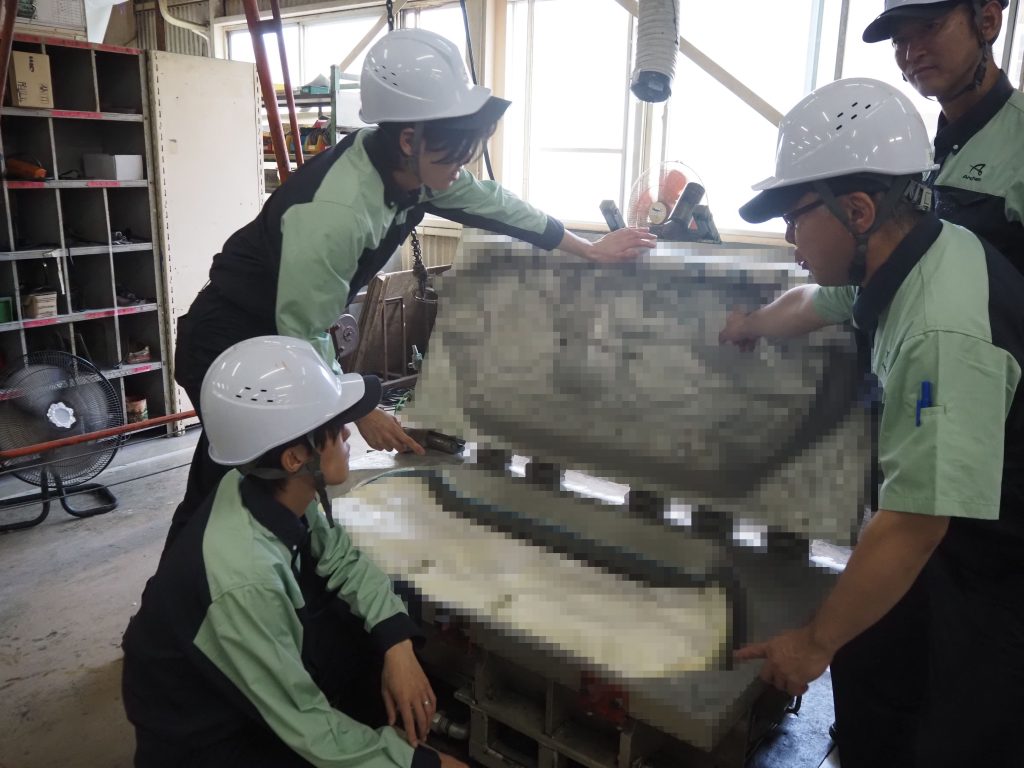
If there is any abnormality with the mold or product, the team members will immediately gather and discuss countermeasures on the spot.
| Working together across departmental and company boundaries: A quality improvement project that overcame obstacles.
—Among the stories of how the entire factory worked together to overcome challenges, are there any that particularly stand out in your memory?
Fujikawa: This is a quality improvement project for products for a new vehicle model that I recently worked on. At first, there were a lot of challenges, but we proceeded with the cooperation of not only the Hofu Plant but also the development team at headquarters and members from other plants. We looked for the causes from various perspectives and, after about a year of working together across departmental and company boundaries to repeatedly make improvements, we were able to significantly improve quality.
Tanabe: This time, we received support from many people at other factories. There were times when we didn't see results, but we persevered and made adjustments based on the advice we received, and I was really happy when we achieved our goal. In particular, Fujikawa took on the role of leader in promoting the activities this time, so I think that joy must have been all the greater for him.
— So Mr. Fujikawa was the leader! It was a project that lasted about a year, so it must have been difficult to maintain a positive attitude throughout.
Fujikawa: To be honest, there were times when I felt quite down. At my worst, it even appeared in my dreams (laughs). In my dreams, everything would go well, but when I woke up, I would realize that there were still challenges in reality and I would feel down again... But each time, I was supported by the people around me, and I was able to move forward little by little.
Fukuda: Even just watching from the sidelines, I could tell he was really struggling at one point (laughs). But even in situations where most people would want to give up, Fujikawa never ran away. He would even come in to check tests that couldn't be done while the line was running, taking advantage of the machine's stoppage. When I think back to whether I was able to work with that much passion at his age, I'm truly humbled.
— I understand that after this project, Ms. Fujikawa requested to be transferred to a technical position.
Fujikawa: Until then, our collaboration was mainly within the Hofu factory, but through this activity, I was able to connect with many people beyond the boundaries of our respective locations. I was able to quickly solve problems I was currently facing by referring to examples from other factories, and vice versa. That's when I strongly realized the importance and enjoyment of sharing knowledge, and I requested to transfer to the technical department because I wanted to contribute to improvements through a more technical approach. Now I find it very rewarding to absorb successful examples from other factories and bring them back to the Hofu factory.
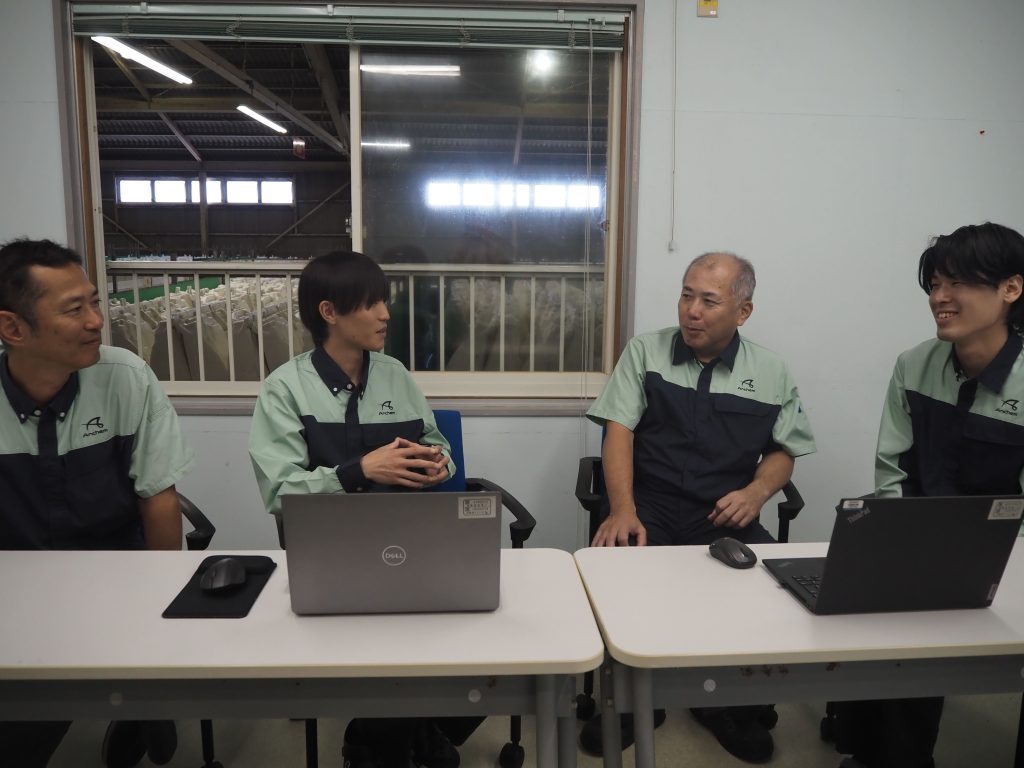
The roundtable discussion was conducted in a friendly atmosphere from start to finish, without any barriers between departments or positions.
| A "nurturing culture" that warmly supports the challenges of its members.
— Earlier you mentioned how you were supported by those around you whenever you felt down. How do you, Fujikawa and Koyama, feel about the presence of the veteran members?
Fujikawa: That's right... Everyone thinks of him as their father.
Tanabe and Fukuda: Your father?! Is there really that much of an age difference? (laughs)
Fujikawa: We're quite far apart (laughs). But that's how warmly supportive he is. So I want to become someone who can warmly welcome my juniors like family.
Koyama: I'm the youngest here, so I already think of Fujikawa-san as my "big brother" (laughs).
The operator position I'm currently taking on is also thanks to Ms. Fujikawa, who kindly listened to my concerns. At first, I struggled to get used to the job and sometimes felt discouraged, thinking, "Maybe this isn't for me..." But Ms. Fujikawa and my senior colleagues warmly encouraged me, saying, "Everyone struggles at first, so it's okay," and "There's no need to rush," which helped me overcome those difficulties.
— It's wonderful to see that a warm "baton of nurturing" is being passed on so well.
Fukuda: At the Hofu factory, there's a strong sense of camaraderie where young people can grow freely, and veterans watch over and nurture them. I hope we can continue to cherish and pass on this wonderful culture in the future.
Fujikawa: Speaking of culture, I really like what Tanabe often says: "Let's create things that can only be made in Hofu, and create value that can only be made in Hofu." I want to continue creating that kind of "value that is unique to Hofu"!
— Mr. Tanabe, could you tell us what you meant by those words?
Tanabe: With so many factories across the country, I believe that having a core principle like "This is how things are made in Hofu" or "This is the value of Hofu" allows each member to more deeply appreciate the value of manufacturing. We want to spread Hofu's unique technologies and initiatives throughout the entire group and aim to become a pioneer for each factory.
[Editor's Note]
What impressed me most during the interview was the overwhelming sense of family and teamwork at the Hofu factory, symbolized by Mr. Koyama and Mr. Fujikawa's words: "If you're worried or in trouble, you'll be found even if you're hiding," and "Everyone is like a father to the others."
Behind the speedy response that leverages our close relationship with customers lies a deep trust between veterans and younger employees who support each other's challenges, transcending departmental boundaries. We hope that this article will give you a sense of the charm of the Hofu factory, where everyone enjoys both work and private life to the fullest.